Terrifying figures lay bare the sorry state of UK’s Armed Forces if WW3 breaks out | World | News
There are concerns over the size of the UK Armed Forces (Image: Getty)
After decades of repeated cuts, the decline of Britain’s military power has been exposed in the past week. Sir Keir Starmer’s response to the war in the Middle East has faced widespread criticism and revealed the truth about the sorry state of our Armed Forces as tensions continue to rise across the world.
Allies in the region are said to be unimpressed, while the deployment of HMS Dragon to help protect British personnel stationed in Cyprus following a drone strike has been widely regarded as far too sluggish. “Hollowed out” is a term we have repeatedly heard over the years to describe the state of the Armed Forces. And looking at the latest personnel figures, it’s easy to see why.

HMS Dragon is preparing to depart to waters around Cyprus (Image: Getty)
Royal Navy
Let’s start with the Royal Navy which has found itself in the eye of the media storm due to HMS Dragon and her pending mission in the Eastern Mediterranean.
As of October 2025, the Navy, including the Royal Marines, had 27,820 full-time trained personnel — a decrease of 1.1% on the year before and around 5.7% on 2022.
In fact, the Navy today is less than half the size it was in 1991 at the end of the Cold War (62,000).
Of course, the nature of warfare has changed over these years, and autonomous systems are increasingly becoming important, but this is a clear example of how defence has fallen down the pecking order in Westminster in the past decades.
The Senior Service’s major warships include two state-of-the-art aircraft carriers, six destroyers and seven frigates.
The ageing Type 23 frigates are continuing to decline in number, while the aircraft carriers and Type 45 destroyers have also faced availability issues.
The Senior Service also has five attack submarines and four Trident subs; however, these have also faced problems, notably with maintenance.

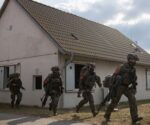
British Army troops (Image: Getty)
British Army
The British Army’s fall in manpower has been well-documented and controversial.
Latest figures show there are 70,300 full-time trained soldiers, an annual decrease of 1.5%.
The Army is less than half the size it was in 1991 (148,000) and also considerably smaller than in 2003 (112,000) when the UK joined the US in invading Iraq.
Much has been made of how the Army has shrunk to its smallest size since the Napoleonic era.
Concerns have led to renewed calls for conscription to be reconsidered to beef up the force.
Many point towards the war in Ukraine as evidence of how mass remains crucial in modern conflict.

F-35B at RAF Akrotiri, Cyprus (Image: Getty)
Royal Air Force
The Royal Air Force remains the smallest branch of the Armed Forces, but it has dwindled in size too.
The RAF has 27,560 full-time trained staff, a decrease of 1.5%, latest figures show.
In contrast, the RAF was made up of 88,000 personnel in 1991 — more than three times the size it is today.
The Air Force is preparing to welcome additional aircraft, including more F-35B fighter jets and the Wedgetail airborne early warning and control aircraft.
Experts have long voiced concerns over the size of the RAF.
Last year, former RAF commander, retired Air Marshal Greg Bagwell, told the Express: “It’s a very high-end capable force and the kit that we’ve got is some of the very best kit available.
“The problem is that you can count it on one hand sometimes and that’s the issue.”