Superb Singing at the Royal Opera’s Ariodante | Theatre | Entertainment
A dysfunctional royal family may seem commonplace these days, but the plot of Handel’s Ariodante is even more shocking than we are used to. An ageing medieval Scottish king is worried about who will succeed him. He doesn’t think his daughter Ginevra is quite up to the job, but she is about to marry Ariodante of whom the king thoroughly approves. The wicked Polinesso, however, wants the crown for himself and devises a scheme to discredit Ginevra.
This begins with his seduction of Dalinda, a servant of Ginevra in the original, but promoted in this production to the role of her younger sister, whom he convinces to disguise herself as Ginevra for an illicit assignment with him. Ariodante falls for the trick, Ginevra is denounced as a whore; Polinesso is delighted and Ginevra and Adiodante are close to suicide. But of course, there is a happy ending, though not as happy as it ought to be.
Ariodante was first performed at Covent Garden in 1735 and was revived in 1736, but has not been seen there since. Why it should be ignored for almost 290 years is a mystery, as it contains some of Handel’s most glorious music, but perhaps the answer lies partly in its four-hour length and the fact that when it first appeared, there were ballet sequences at the end of each of its three acts, which made it even longer. On seeing the current production, which omits the ballet, one might also feel that it has taken 290 years to assemble such a stunningly perfect cast.
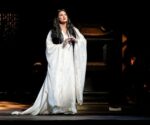
The roles of Ariodante and Ginevra are as close to perfection as one can imagine. Canadian-Italian mezzo-soprano Emily D’Angelo in the title role was a delight to listen to, while American soprano Jacqueline Stucker as Ginevra was equally astounding. Quite apart from having gloriously appealing voices, they both had the perfect technique to cope with anything Handel cared to throw at them in terms of speed and range, while also showing heart-rending ability to cope with the diversity of emotion demanded by the roles. Both of them stunned the audience into silence, followed by tremendous applause, when they delivered grief-stricken arias as their worlds fell apart.
One expects the Royal Opera to produce one or two star performances, but on this occasion everyone in the cast was astounding. French countertenor Christophe Dumaux produced exactly the right balance for Polinesso, wicked without being melodramatic; Cuban-American soprano Elena Villalón was delightful as the naïve Dalinda; Slovakian bass Peter Kellner was impressive as the King of Scotland, despite being forced to spend his time in a bed or wheelchair for most of this production.
The Orchestra of the Royal Opera played in fine style, with several period instruments including the splendidly twangy sound of a theorbo. French conductor Stefano Montanari also amazed those of the audience who could see him by his virtuouso playing of a violin which he occasionally picked up to give his conducting added vitality.
My one reservation of the evening was the work of the Dutch director Jetske Mijnssen who introduced some thoughtful changes, including massive modernisation of the plot, but seemed to me to be going a little too far in places, producing something of which Handel would not have approved. The worst of these was perhaps the change of ending, when what we saw on stage did not tally with what the characters were saying or the music that accompanied them. But with five-star singing, five-star acting and four-star direction, it still averages out closer to five than four stars.
- Ariodante will be performed at the Royal Opera House on various dates until December 21. Box Office and details via roh.org.uk or 020 7304 4000